
Why a Context Layer Is More Than a Knowledge Graph
How financial institutions can answer audit, migration, and workflow questions in seconds instead of months.
In What Your Organization Should Demand from Its Context Layer, we set out what a context layer has to deliver. This piece goes one level deeper, into the distinction that determines whether it works at all: the difference between the graph that represents your enterprise and the layer that makes it answerable at the moment a decision is made.
The two terms are often used interchangeably. They describe different things, and the gap between them is where most AI-ready data programs quietly stall.
The Industry Problem Is Not Awareness. It Is Connection.
Financial institutions know their risks. They have frameworks, processes, and tooling. What they lack is connection between them, because those tools operate in silos.
Take a consumer loan division. It inherits the board's risk appetite, maps it into its processes, and builds operational controls. Frequently those controls are defined just precisely enough to satisfy a control-maturity score. When the time comes to test them, most fail. The specificity is missing. The controls are detached from the loan origination systems they are supposed to govern.
Most GRC tools address this by pulling sample data from the loan application, testing the control against it, and managing the resulting findings. This sampling-based, point-in-time approach has not served the industry well. The control, and the risk it maps to, breaks down the moment the underlying application is upgraded or migrated to a new vendor.
When that happens, the questions come immediately:
Which models are impacted by the loan application upgrade or migration, and who are the data owners of those models?
What residual risks in the application have to be addressed during the migration?
The sample questions are listed here. To answer these, institutions spend months on documentation. The information exists. Nothing connects it. This is precisely the problem a context layer is built to solve, and it can do so in seconds.
Structure Versus Meaning
To be precise, three layers are in play, and naming them correctly is the whole point.
Ontology, the schema: Institutions define an ontology of enterprise risk management: the key domains, including regulations (federal and state), industry frameworks, risks, controls, policies, data, data elements, AI and ML models, and control-assurance results such as data quality, findings, and issues. Each domain is enriched with properties, and the relationships between entities carry properties of their own. The ontology is the blueprint. It holds no instance data. The engineering of the logical schema is outside the scope of this post.
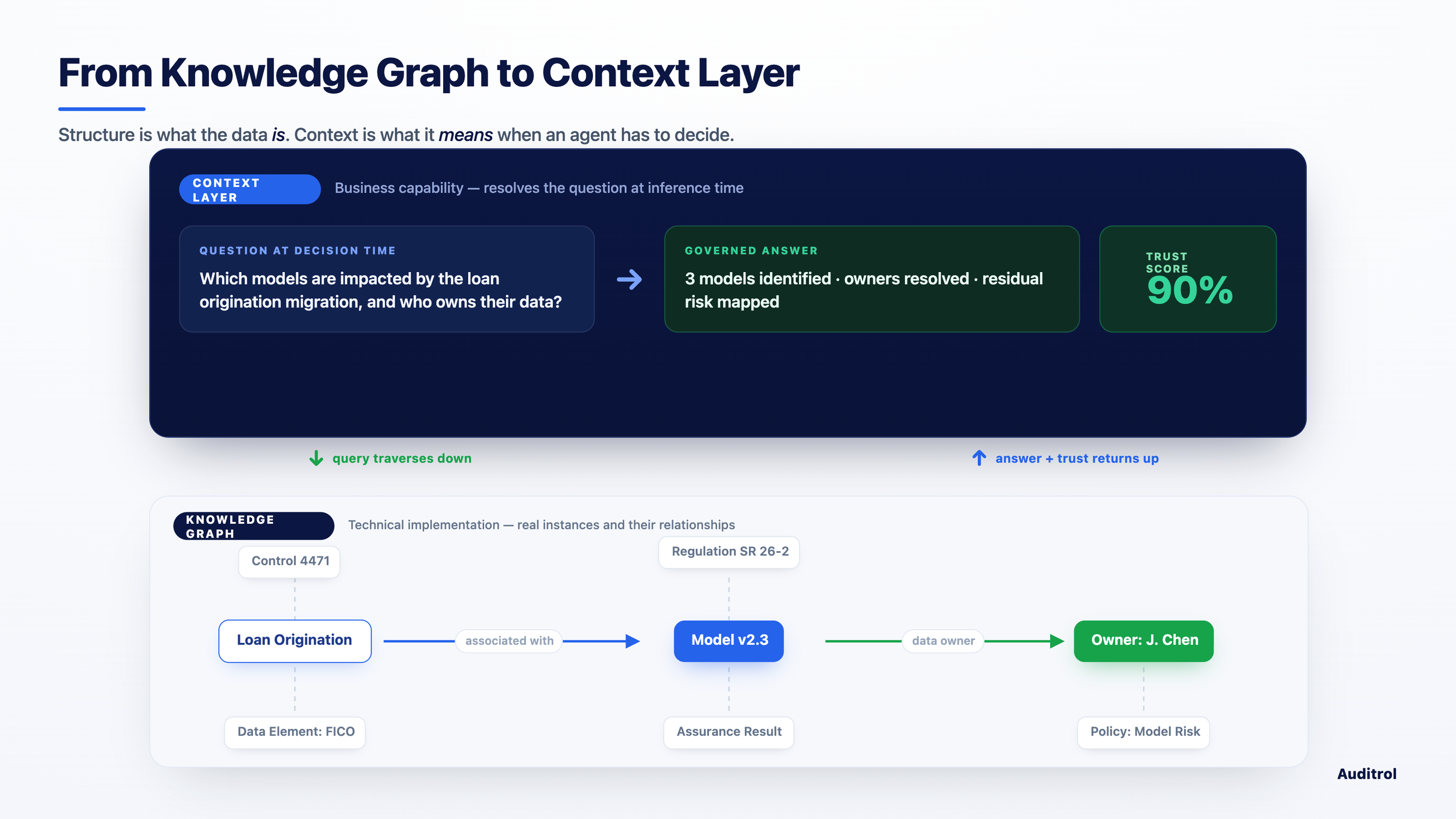
Knowledge graph, the technical implementation. Populate that ontology with real instances and you have a knowledge graph: the structural representation of your institution and the relationships inside it. This is the technical layer.
Context layer, the business capability. The context layer sits on top and resolves questions against the graph at inference time. It is the business representation, built on the knowledge graph, which is in turn an instantiation of the ontology.
The Migration Question, Answered By Traversal
Return to the question we started with: which models are impacted by the loan application migration, and who are the data owners of those models?
Once the knowledge graph is implemented, the context layer answers it by traversal. It resolves the loan origination application from the properties of the controls attached to it. It follows the “associated with” relationship to the models that depend on that application. It reads the owner from each model's properties. It returns the impacted models and their data owners.
In this example, the loan application, its associated models, and their owners are the context. What took months of documentation becomes a query that resolves in seconds.
A Sophisticated Context Layer Returns Answer and a Trust Score
Sophisticated graph architecture does not eliminate the need to verify a result. That is why a mature context layer returns the answer together with a trust score.
The score is earned through a defined process. Each business process is evaluated with a set of questions. A subject-matter expert answers them, because only the people who run loan origination can explain how the process actually works. Those questions are fed into LLM judge and responses are compared against human answer, and scored accordingly. These evaluations are baked in ahead of time and continue to be graded through a feedback loop when users interact with the context graph via search.
The human remains the source of process truth. The model makes that truth measurable and keeps it current. This is trust but verify, operationalized rather than asserted.
The Problem Predates GenAI. GenAI Makes it Urgent.
The context layer earned its attention because of GenAI, but the problem it solves reaches well beyond any single AI use case. At its core it is about connecting what an institution already knows so that a person or an agent can act on it reliably.
GenAI raises the stakes. It makes the question harder to answer manually. As institutions extend risk management to cover AI itself, legacy tooling cannot identify AI risk. Collecting data on prompts and data leaks after the fact means the exposure cannot be traced, and cannot be blocked at the moment of the query.
Enterprise risk management is undergoing this shift: moving beyond managing a static library of controls toward operating a living control ecosystem.
A context layer is a practical starting point for applying GenAI to enterprise risk management. Request a demo to see how Auditrol can help.